Sunday, August 13, 2017

BC Liberal Leadership Platform Briefing


Scroll Down to Review Briefing


Accountability

I have watched politics and its outcomes for years; I can hardly remember a circumstance where the political process has generated a completely rational outcome. One recognizes the need for compromise among various constituents in the making of law, there should be no compromise in its functionality once it is put into practice. Accountability is sorely lacking, we must have clear and concise reporting on the outcomes of laws made, that is to say, every law must have a clearly stated mission, there must be a set of metrics established, they must be monitored and clearly reported to the public by an arm’s length actor. Until we do that, we will see public opinion swayed by constant exposure to smoke and mirrors rather than rationalized to real outcomes. 
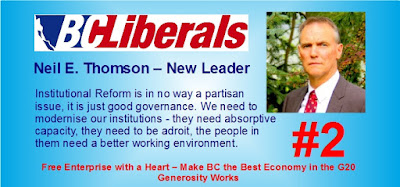


Institutional Reform

It is the case that many of our institutions have lost the ability to adjust to the realities of the modern world as they have evolved into existence, in some cases they have evolved over hundreds of years – we need organizations that are DESIGNED to deal with the reality that we exist in, an environment where technologies morph daily. Institutions need to be adroit and have the absorptive capacity to utilize the mass of new technologies available now and technologies that are on the horizon. The majority of our government institutions are just too big and the institutional inertia they are experiencing is preventing them from responding to demands; efforts will be directed toward their long term financial sustainability, more adroit response to change, greater focus in their mandate, a drive to increase absorptive capacity, and better and more productive working environments for the people employed. Reforms will be effected by reducing the mass of large institutions, reconfiguring their organizational structures and introducing more opportunity for heuristics to come into play in the development of government organization. Stagnation is always a bad thing in an organization, there needs to be disruption to effect progress and improvement in the functionality of government organizations; this is especially true given the dynamics of the modern operational environment.   

Human Capital is the sub straight of the human endeavour, we all know it, we all say it, but the truth is, this value fails to find complete expression in our present governance. In order for British Columbia to excel relative to other jurisdictions, the development of Human Capital must be the primary focus of Government. I believe it is the case that, jurisdictions that facilitate the conversion of new knowledge into useable products and services are the jurisdictions that will prosper. We can readily quantify the benefit of the application of knowledge, that is to say,  we know the increased tax revenue garnered from dentist relative the norm for example. Government tax revenue is a direct product of any given jurisdiction’s population’s ability to generate income. Increase aggregated intellectual capacity and you increase government revenue.  Education should be accounted for under a WIP account as opposed to an expense account and a graduate student should be viewed as a capital asset - education is infrastructure spending of the greatest significance. We can afford to be generous here, the fact is, we would be remiss if we failed to invest heavily in education.

In many of our institutions, more money just means more spending – this is true to a degree with our educational complex. We have failed to take complete advantage of self-directed and technology driven delivery platforms for education.  Our educations systems are constrained by present structures and credentialization processes.  There needs be a focus on an increased velocity in the distribution of knowledge, so as to facilitate the province's prominence in the conversion of latent technology to marketable products and services, and perhaps most importantly, to compete with jurisdictions like China, India and others which are generating massive volumes of trained professionals every day.


Family Policy and Support

I will promote policy that generates family centred funding, gives priority to families having time together and supports them interfacing with society in a manner that is optimal for their specific needs. The British Columbian Family as an institution is quaking under the strain of post war societal trends and contemporary economic realities. I used to say, I paid to raise my children, this generation should pay to raise theirs. When I reflect, I could have used a culture of support and promotion of family from government and it was absent.

There is an alarming trend is society whereby, every aspect of our existence is institutionalized. We are born in government institutions, we are educated by government institutions, every aspect of our life is affected by government institutions and we die in government institutions. In this heavily institutionalized environment, the individual and the family are withering, and they are being replaced by a monoculture. Proper support of families is one policy initiative that can protect against the industrialization of child rearing, the destruction of the family and the social ills that fall out of it.


Fiscal Policy

I will seek to move the provincial growth to the top performing region in the G20 by aggressive use of region specific stimulative policies that seed entrepreneurialism and build the economy from the ground up. In British Columbia, like many western economies, we are ageing and with an ageing population comes economic stagnation. We are lucky as this is being mitigated to a degree by immigration, the fact remains, however, that many people are moving into retirement taking their productive capacity with them and they are seeking a safe place for their retirement funds. There is a massive amount of latent capital sitting in RRSPs generating very little good for their holders and failing to find their way to the people that really need capital, entrepreneurs.  This reality provides an opportunity to engage in a form of quantitative easing that benefits in a significant way the existing middle class and builds out a new group of good income earners.  If the government moves to the aggressive use of partially subsidized bonds to generate a localized increase in the velocity of the flow capital to startup companies and critical infrastructure initiatives, it will facilitate an immediate increase in economic activity and the medium and long term economic performance will be improved as well.    


Rural Revitalization

One is forced to accept there is a trend taking people away from rural areas to urban centres, one should never accept the many of our rural communities are mere shadows of their former selves. So rural revitalization will be pursued through improved utilization of crown land, high capacity internet infrastructure for remote areas and the productive cooperation of the First Nation Peoples. There is much opportunity in forest tenure reform, tourism, agriculture, crown land utilization reform and new industry to build out the rural regions of the province.


Environmental Policy

Finally, an aggressive environmental policy that is rationalized to realistic time lines, realistic assessment of risk versus reward, considers honestly where provincial policy can effect difference and is founded on science. It is my observation that much environmental policy or rather, obstruction to certain types of industrial activity, is founded on an errant map of reality. It is also the case the much environmental policy is corrupted by interested parties wanting to forward certain social agendas. There is a lot to be done in the way of conservation that government can help encourage, as well as, in the energy alternatives space and safe fossil fuel use space.

Tuesday, August 1, 2017

BC Liberal leadership bid

My name is Neil Thomson and I was born in White Rock, British Columbia and have called this province my home since. I had the privilege of being raised on a farm and then due to my father’s passing my family left the farm. Again another privilege came my way, we bought home on Kalamalka Lake in Vernon, so summers were spent swimming and winters skiing at Silver Star.  As a young man, I lived in Revelstoke, Dawson Creek, Logan Lake and then moved to Kamloops in 1984 and raised my family.


Over the past years, the Liberal Party leadership has taken a rational middle of the road approach, much of which I find accord with. My self-imposed mandate will be to stay the course with the rational middle. I will drive enhanced accountability measures by the appointment of an independent nonpartisan Accountability Officer who will be tasked with the objective assessment of government policy outcomes and provided with a communication channel to the public. I will bring focus to institutional reforms across government, including but not limited to, medical system reforms and education system reforms.  Specific to Education there will be a focus on an increased velocity in the distribution of knowledge, so as to facilitate the province's prominence in the conversion of latent technology to marketable products and services - this will be funded as an infrastructure investment and costed against the longer term substantiated tax revenue increases the policy will generate. Institutional reforms will be focused on breaking the present inertia our institutions are experiencing that is preventing them from responding to demands; efforts will be directed toward long term financial sustainability, more adroit response to change, greater absorptive capacity, and better and more productive working environments for the people employed. I will promote policy that generates family centred funding, gives priority to families having time together and supports them interfacing with society in a manner that is optimal for their specific needs.  I will seek to move the provincial growth to the top performing region in the G20 by aggressive use of region specific simulative policies that seed entrepreneurialism and build the economy from the ground up. One accepts that there is a trend taking people to urban centres, one can never accept that many of our rural communities are but mere shadows of their former selves – so focus will be brought to rural revitalization through improved utilization of crown land, high capacity internet infrastructure for remote areas and the productive cooperation of the First Nation Peoples.  Finally, an aggressive environmental policy that is rationalized to realistic time lines, realistic assessment of risk versus reward, considers honestly where provincial policy can effect difference and is founded on science.

"Jurisdictions that facilitate the conversion of new knowledge into usable products and services are the jurisdictions that will prosper."

I am advocating substantive change in the structure of many of our institutions, I am advocating this change because I know our potential and I can see what is holding us back. People fear change, they will speak against it out of fear. People want security and so in the “change process” efforts to assure people garner an enhanced circumstance will be sought, or at least, their livelihoods will be maintained.

I am eager to bring a generalized state of prosperity to the Province, to seed the economy from the ground up and to effect a more equitable circumstance absent redistributionist action – let people keep what they’ve earned.

To prevail in this race I will need a lot of help, with funds and political expertise. The established players in the leadership race hold a small amount functional advantage, as they are incumbent actors. I believe I can prevail by presenting a clear vision to British Columbians and letting them see the kinds of reforms that will make it happen. I hold a deep and abiding passion for the betterment of my province, forged by a love for the place where I've spent my life at work and play. There truly is no better place on earth, no place with more natural wealth, no place with stronger people, no place with more compassionate people; all that is needed is the right direction.

If what you've read makes sense to you and you have expertise or funding you can offer to the cause, please call or reply by return email. One understands the nature of the undertaking and the dynamics of the process - it is a big commitment and one I am happy to make. I know I can do it and I am confident if provisioned with the right support I can win. I am eager to turn British Columbia away from economic stagnation, to get in front of the money that will be running from the province under the present leadership - AND, most importantly, I am eager to make British Columbia the most prosperous jurisdiction in the G20. 

Free Enterprise with a heart
Make BC the best jurisdiction in the G20
Generosity Works 

Thank You
Neil E. Thomson
250-819-6950
nthomson20@gmail.com


Monday, July 24, 2017

Fight Fires AND Stimulate Rural Economies


Part of the challenge with wildfire is fuel load, that is to say, that over time when you control fires fuel builds up – then when conditions are opportune, the fire starts and is more severe than if the fuel load were reduced by regular fires or other means. It is the “other means” that interests me, how can we reduce the risk of fire and spare ourselves the smoke. Much suggestion for mitigating the severity of wild fires centres around controlled burns, perhaps there is another solution.

It has also come to my awareness that thinning and limbing, a part of the interface treatment process and an essential part of good forest management offers a substantive return on investment. Numbers I was provided indicated an approximate 5% / annum return on invested capital for thinning and limbing (this number is dependent on the various timber types and growing conditions – 5% is a conservative number).

The question becomes, how to fund Thinning and Limbing and garner the double benefit of increasing forest productivity and reducing the risk of forest fire – (reducing forest fire risk would require a slight expansion of normal prescription for thinning and limbing). If it were private land, ownership would seek a capitalization medium to fund a process with a known return. In the case of government, silviculture practices, as fire prevention, tend to be viewed as an expense rather than an investment. In light of a known of a known return, there is an opportunity for the government to fund silviculture programs at little or no real cost to the government.

The government could develop a silviculture bond program, that is to say, it could issue bonds at a given rate of return to the public against the anticipated return generated by various silviculture programs.  There is a tremendous amount of benefit that is derived from silviculture, the forest production increases, fire risk is lowered, the tree production cycle is shortened, there is immediate employment in the activity and related multiplier effect and there is the maintenance of an industry critical to rural British Columbia. While there is a 5% or better direct return, there are other benefits, the quantification of which is outside the scope of this document, but common sense would indicate are significant.  Given this reality, the government could issue bonds with a rate of return at a few points over the expected rate of return the increase in fiber would generate; offering opportunity for a British Columbia Forest Bond with a rate of return perhaps as high as 7 to 10% - by present day standards, a rate of return that is attractive especially when supported by a provincial government.


A policy like this does two things, it reduces the cost of silviculture processes, and it, in effect, “subsidises” retirement savings. If done aggressively is would be a form of region specific “quantitative easing” directed at the “RRSP” security seeking investor – highly stimulative.  We need a policy like this due to the nature of our population, in the same vein as Japan but to a lesser degree, British Columbia is stagnating somewhat, if not overall, most certainly in the rural economies – simulative policy is required.


MORE THINKING ON THE SUBJECTS OF FISCAL AND FOREST POLICY

Wednesday, July 19, 2017

Canadian Cultural Identity & Rural Life


Ode to rural life and the new urbanised Canada
"Canada was built on rural life and values; independent people seeing to their own needs and answerable to themselves."
"In rural life children are exposed to the facts of life and the realities of natural systems early, inherent in their existence is an attachment to the land and our tentative alliance with it and its other inhabitants."  
"There is a temptation to wax on about the bucolic majesty of rural existence, I find it hard to overstate rural existence’s value or to lament thoroughly enough its waning influence." 

As a child I spent time following my father around the farm as he did his work and as many farmers, he had a dog – Tweed a hard-working Border Collie. Tweed and I stood approximately the same height and in Tweed’s mind that put us on equal footing. Equal footing in Tweed's mind met he felt the need to attempt to assert dominance, so in my father’s absence, I found myself often seeking safety from Tweeds bared, bright white canine teeth. At nearly age five my father passed away leaving Tweed and me to live life by whatever arrangements we might make. In the spring of the following year on a sunny day I had taken up a spot on a sheet of plywood on a sawdust pile; sitting there day dreaming and enjoying the sun. I looked up to see Tweed slowly making his way toward me, given our previous exchanges this was a less than welcome occurrence. With nowhere to go, I choose to sit quietly and let things unfold, and there I sat – in suspense, waiting to endure whatever outcome befell me. Tweed circled wide around me in an arching pattern and slowly with his head down made his way to me, when he was a couple feet away the situation was growing more uncomfortable; then, to my relief, rather than baring his teeth, he lay down beside me and put his head on my lap. Gingerly I placed my hand on his head and stroked him as my father had done. It seemed in my father’s extended absence Tweed preferred my company to none. Tweed never became my dog, but an amicable truce lasted until Tweed's usefulness around the farm was over. 

In rural life, children are exposed to the facts of life and the realities of natural systems early, inherent in their existence is an attachment to the land and our tentative alliance with it and its other inhabitants. Tweed taught me about vulnerability and to seek remedy through language unspoken – one neurological system to another. The lessons associated with rural life are many and all valuable. The lessons provisioned by rural life are sorely absent now as our children exist in an urbanised world.

There is a temptation to wax on about the bucolic majesty of rural existence, I find it hard to overstate rural existence’s value or to lament thoroughly enough its waning influence. The farm teaches appreciation of the strong and the value of the weak, as even a sickly animal, if nurtured properly has value. Rural life teaches self-reliance, exposure to natural systems and all the related sundry experiences make it possible to judge the seriousness of an illness without going to the emergency ward and provides the inclination to exercise such judgment. Most rural circumstance has people exposed to the full gambit of endeavour, from building the shed, playing midwife to a heifer, to planning a risk management strategy for their wheat crop and inputs. It is rare in an urbanised setting for a single individual to gain exposure to the whole production chain, particularly one as complex and containing the natural systems related to rural life.

Canada was built on rural life and values; independent people seeing to their own needs and answerable to themselves. Most people in a gainful occupation in a rural setting produced and sold a commodity. The wondrous thing about a commodity is that the channels to market are absent of any direct customer, products are sold into a large pooled market or at auction. This met people who derived their livelihood from the land really were able, more than others dependent on employers or exposed to public opinion in some way, to be critical thinkers. Critical thinkers, self-reliant with limited exposure to public pressure and a thorough knowledge of natural systems, it is hard to imagine a better collection of people to build a country.

Living in a sparsely populated rural setting often your only help was a neighbour, your only social opportunity was a neighbour – needless to say, you valued your neighbour whether you liked them or not; this is a unique type of association that builds tolerance for difference. The community was tight and small, which breeds accountability. E. F. Schumacher in his book Small is Beautiful gave an enlightened example of small community life, he said when you live in a community of 100 people it’s pretty hard to steal your neighbour’s shirt because he’ll see you wearing it. Even in the absence of the strong citizenship that rural community developed, small communities have a way of making you accountable to people that is absent in large urban settings.

The harsher side of our reliance on the land is found in rural settings. I once spoke to a teacher that use to take kids to a slaughter house every year so they could become acquainted with the realities of harvesting livestock for food. In the 1970’s he would ask the students if they had ever killed anything, 70% would respond in the affirmative the same question 20 years later failed to yield more than a couple affirmative responses. I suspect you would find similar responses to a question related to weeding the garden. The almost complete divorce from husbandry and interaction with natural systems creates a mindset of alienation to sources of sustenance and their processing. I believe, even though there is a dominate acceptance of the utilisation of animals for human sustenance, there will be growth in the animal rights movement as people evolve away from immediate contact with animal husbandry.  

When one contemplates the complete complex associated with traditional rural life in Canada, one realises what an effective rearing environment it was/is for children. The rural community’s waning size and hence influence on our society has reduced the input of a unique and important component of Canadian society and along with that input, an important part of Canadian identity.  

The urbanisation of Canada is accelerating. Cities offer a technological, cultural and social dynamic that fuel effectively the new and complex economy. In contrast to our urban settings, in the rural setting’s socioeconomic mingling was a natural element to daily life, keeping all walks of life in contact in the same social complex. In urban centres, it is possible, in fact likely, that people can occupy an entire day having only engaged within their socioeconomic strata or perhaps as specific as the same occupation. The irony of the mass of humanity in large urban centres is you’re likely to see less of humanity and experience isolation. This creates social cliques who tend to breathe their own air while the world outside a specific area of endeavour passes by. Again, in contrast to rural society, occupation is so finely specialised peoples scope of thought tends to narrow. Where the farmer is contemplating fiddleheads, Fallopian tubes and finance, the computer programmer is writing one piece of code for a program, or a biotech worker is manipulating a gene for a given bacteria. As was once said, “An expert is someone who knows more and more about less and less until, eventually, he knows everything about nothing.” As a student of Adam Smith, specialisation is enthusiastically embraced; however, a large bank of broad spectrum thinkers is most useful in the process of building a nation and a nation’s identity. 

Tuesday, July 18, 2017

BC Wildfires – Causal Factors - Forest Care Matters

As is often the case in managing anything, strategy determines the outcome and no amount of genius in tactics will remedy a poor strategy; if this is true, we know that no predetermined strategy will generate the same frustrating circumstance of applying tactics without satisfaction in the outcome. 


The assessment of what is causing the “increase” and “intensity” of forest fires is beginning to roll in. One listens to the forest experts, fire experts, talking heads – they are all very intelligent people who have been examining the challenge under the rubric of existing policy and governance. Their thinking is forged by government policy, forest management history as it is affected by provincial policy and their solutions stem from tweaking existing policy – they are in effect essentialists – their map of reality is predetermined. The single constant element of all suggestions is more funding.  I am in no way belittling incumbent actors or experts, I know many and have a tremendous amount of respect for them – their hands are tied by a myriad of factors.

Forest policy in British Columbia, like much policy, has EVOLVED under a collection of human interests; largely socioeconomic, which results in action that is abstracted away from the realities of the forest itself and oft times the highest and best outcomes from an enviro-socio-economic perspective. The best forest policy emerges from a sound understanding of the natural systems at play, the outcomes that are desired and then design thinking being brought to the challenge to generate policy. As policy has EVOLVED, the policy has generated no clear long term strategy and as a result, there are many Faustian elements in practices undertaken.   

There are only two factors that matter in forest management, the natural systems in the forest and how we as humans interface with those natural systems.  You're thinking, thank you for stating the obvious, while this is obvious – the power of vested interests and the resulting institutional inertia have, in many cases, divorced us from this obvious reality.

By way of example; I did some work related to assessing various land “units” that have as a large component of their value in timber. I contacted some staff at the Forestry and they were kind enough to provide data with respect to the economic value of various silviculture treatments. Thinning and limbing generated an approximate 5% per annum return (this return is a product of achieving a viable stem more rapidly and hence intensifying land use) – this is a general number for the purpose of illustration, it varies depending on stand type and other factors. So why are we failing to thin and limb forests in a significant way? Some takes place, but there are billions of hectares of forest unattended to.  

As forest policy has evolved and by extension, the way we interface with the land has put us in a curious circumstance. We are the best in the world at milling lumber. Very few, if any, jurisdictions can compete with the “manufacturing” aspect of our industry. We are the most proficient in the world at harvesting timber – the complex of equipment and technology we use is unparalleled. Yet, when it comes to managing the forest itself, the foundation of our forest industry we do poorly; one symptom of this reality is the wildfire challenge. The mills are owned assets and production is constantly rationalised to returns. The harvesting processes are performed by owned assets and constantly rationalised to returns. The forest is held as a public asset and forest harvesting rights are in large measure “volume” based (companies are sent to various places in the forest to take trees then they leave) – there is no connection between a given land-base and those reaping its benefit. This has resulted in reality that has us being “tree harvesters” rather than “tree farmers”, as such the land-base is largely unattended to.   

To a degree, what has emerged out of the evolution of forest policy is the quintessential tragedy of the commons. There is a single steward of the forest, the government, the challenge is, the accountability loop is long and unclear and the management perspective is more influenced by the short term interests of a multitude of actors and political reality, than by the health of the forest or even the industry itself.  How does this relate to wildfires you ask? It has to do with the attention paid to any given hector of land and in the case of fire concerns, the immediacy of the threat to the affected party’s livelihood.  

In Sweden, where tree farming is common practice and often an extension of an aggro enterprise – the attention given to a given hector of land is greater, than in BC’s forest. When people live on a given piece of land economic concern is immediate and hence management of a resource is rationalised to returns – but something more happens, people become attached to the land – they are an extension of the land – it is their home – many times for generations.  There is a healthy dynamic that emerges out of the combination of concern for the land and the requirement to make a living from it, a more nurturing management perspective comes to play, as we manage the forest we have a more extractive perspective. When the management of the land-base is “micronized” to a specific acreage,  more effort is applied to production per acre and harvested fibre is delivered into the market in response to market singles rather than other imperatives, as is the case in BC now.

In the case of fire management, for example, fuel load, the primary causal factor in the disaster we’re experiencing now, is better managed in an intensively managed forest that is “farmed”, than in BC’s case where the forest is extensively managed.  Further to the point of attention to the land; a person who owns timber harvesting rights to a given piece of land has a heightened concern with respect to a threat like fire than an entity as defuse as government – which is why we are in the state we are.


Tenure options are many, and one realises that in BC we have many users on the forest land-base, we can develop a tenure regime that protects the tradition of multiple users of the land base, yet captures the management imperatives that the forest requires to maximise its health, protection and benefit to us.

MORE THINKING ON FOREST AND RURAL POLICY


Sunday, July 16, 2017

Transcendence – Why it matters


Transcendence as I understand it, in the context of social development, is a complex of processes by which a given individual can interface with society at large and better their lot relative to their prior generation or, perhaps, achieve exponential transcendence by excelling beyond the average; beyond the average as defined by the socioeconomic and cultural complex in which the individual exists.


Bono, the lead singer of U2, described the effects of transcendence as follows, “when an Irish kid looks up at the mansion on the hill, he thinks “you bastard”, when an American kid (USA) looks up at the mansion on the hill, he thinks “that will be me one day”.”  There is a good deal of power in that belief, one can argue that it is has been monopolised to a specific social group, one can challenge its use and application – no one can challenge that the belief is powerful. It has moved the US to prominence. Now allow me to grant the naysayers a complete acquiescence and say, as the offer of transcendence has been implemented in the US it has been a total failure due to social inequity – which is untrue in my opinion – but even if it was true - which belief do you see as more powerful, the belief that society is managed and you’ll be placed where you’re placed OR that your fate is your own and if you apply yourself, the path to achievement as yous to define.

Desiring individuals to climb the socioeconomic ladder stands in contrast and opposed by the Calvinist and Confuciusian social imperatives, in which, societal stasis is integrated – your father was a lawyer, so you are a lawyer. In England, where my personal cultural underpinning harkens from, the Calvinist social imperatives have migrated to governance in a way that has effected a good deal of socioeconomic stagnation. It is my opinion, and the opinion of many more qualified than I, that this social stagnation was causal in the general fall of British economic performance relative to the USA economic performance over the past couple hundred years.

Say the word “Transcendence” and most business people, or people with a market prominence in their thinking related to economy and government, roll their eyes. Transcendence has gotten a bum rap in these quarters because it is heavily associated with big “S” socialism and the myriad of damaging policy initiatives that have emerged from the left “wing” of the political spectrum. Redistributionist policies like a “progressive” tax system. Redistributionist policy always means taking someone’s money and giving to someone else at the discretion of an inherently unaccountable entity called government. Redistributionist policy is founded on the pursuit of “social equality” as opposed to “social equity” and the belief that the “pie” is finite when the “pie” is infinite.

The formalised development of transcendence in government policy provides an incentive to people to pursue betterment, it is very much a belief mechanism within the societal complex. It is a belief mechanism that brings dynamism and vibrancy to society. It drives growth in the individual and by extension, cultural and economic growth in society at large.  Belief is only sustainable when it is substantiated, people have to see actions and outcomes with their own eyes, to substantiate the belief.

In the past government has pursued transcendence in a damaging way, they have chosen to make people pay for the progress of others. For a transcendent policy to be accepted broadly it must effect benefit for all – a win win. People who have garnered capital want to keep it, people without capital, need capital. The key here is to develop a policy to incent people with capital, to direct that capital to emergent individuals – in this way, the holders of capital gain and emergent individuals gain eventually making the transition to affluence and capacity. There are many ways to have people happily contribute to the process of emergent individuals, the government needs to be more aggressive in this space.


Thursday, July 13, 2017

In defense of my mother’s people

At the dawn of the entity we now call Canada, Toronto was just beginning to sprout. There were twenty houses there, of which one was my great grandfather Middleton’s.  Others there or who came, included, Rowntrees, Taylors and Eatons.  They and other Anglos brought with them British Common Law and British Governance which eventually evolved into the governance structure we have today. I am extremely proud of their and others accomplishments and what Canada has become. The British Contribution to this country is significant and has been a major contributing factor in the creation of one of the most just societies on earth.


There is a constant attack on the Anglo component of contemporary Canadian society, and offered for the basis of this attack are historical actions taken by the British that were detrimental in some way or viewed as racially motivated. What is missing in the critique is the contextualization of these occurrences on the continuum of time, 400 years ago the world was a tribal place, now, thankfully, it is less so. Prior to Europeans coming to North America, North America was a tribal place with the requisite struggling to maintain and enhance territory. Many actors throughout the world were colonising various parts of the world, their actions were that of conquest – they were after the spoils as the British were.

It seems that in contemporary Canada everyone has a reason to be angry at the Anglo component of Canadian society; we are always being forced to apologize to someone for a historical event and oft times the ones requesting the apology have every bit as jaded past with respect to racism as the British do – worse in some cases.


We’ve all landed where we are now, there are contemporary ills we need to answer for as a country to be sure. I must say however, I have a culture too, that is valid – as a Scottish / English hybrid, I am proud of our accomplishments, our contributions to Canada and what we’ve helped to build. We should never have to apologise for our success, we should only use what we have to make a future that is absent actions that generate the resentment we are experiencing in a what seems to be pan-Canadian contemporary pastime – Anglo Bashing.  The British Empire is one of the most successful in history and while there was brutality in its building, looking now in its wake, there is relative prosperity here and the means by which to address errors made.